


Shop now
For generations, Ayurveda and other traditional systems of medicine have used plants and herbs as part of traditional health practices. Today, many of these herbs are also being investigated through modern scientific research to better understand their composition, traditional applications, safety, and potential biological properties.
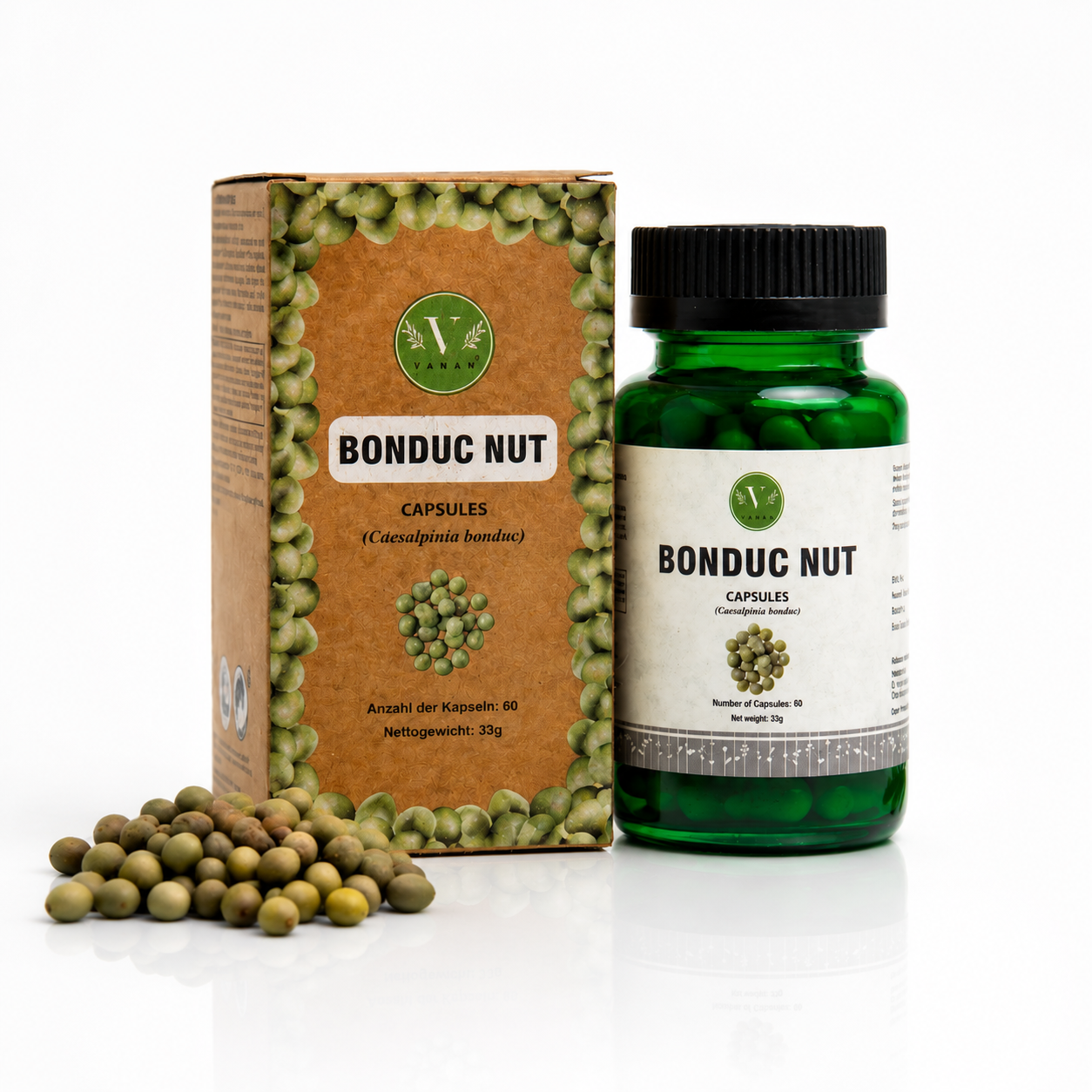
One such herb is Bonduc Nut (Caesalpinia bonduc), a plant with a history of traditional use in India. Vanan Bonduc Nut Capsules contain 300 mg of Caesalpinia bonduc seed extract in a convenient capsule format. But what is Bonduc Nut? What is known about its traditional use? And what does modern research tell us about this botanical?
The Ayurvedic History of Bonduc Nut
Caesalpinia bonduc is an herb that has been used in traditional Indian systems of medicine. It is known by traditional names, including Kuberakshi and Latakaranja. Ayurvedic literature and research publications have documented the traditional use of different parts of the plant.
The seeds, commonly referred to as Bonduc Nuts, have been included in traditional herbal preparations. Traditional knowledge provides an important historical context for understanding how herbs such as Bonduc Nut have been used over time.
However, traditional use and modern clinical evidence are not the same. Traditional use can provide a basis for scientific investigation, while clinical research is needed to evaluate a specific preparation in people.
From Traditional Use to Modern Research
Modern research has investigated Caesalpinia bonduc to better understand its phytochemical composition and biological properties. Studies have identified several groups of naturally occurring plant compounds, including diterpenes, flavonoids, phenolic compounds and other phytochemicals. Research on the Caesalpinia genus has particularly examined cassane-type diterpenes, which are characteristic compounds found in several species within the genus.
Importantly, identifying a compound in a plant does not by itself establish a health benefit in humans. Laboratory and phytochemical findings provide useful information for research, while human clinical studies are needed to understand how a particular preparation performs in people.
What Natural Compounds Are Found in Bonduc Nut?
Bonduc Nut contains a complex mixture of naturally occurring plant compounds. Researchers continue to investigate these constituents to better understand the botanical.
Cassane-Type Diterpenes:
Cassane-type diterpenes are an important group of compounds found in the Caesalpinia genus. Researchers have identified cassane diterpenes specifically from Caesalpinia bonduc seeds and other parts of the plant.
These compounds are primarily of scientific interest because of their chemical diversity and biological activities observed in experimental research.
Flavonoids and Phenolic Compounds:
Flavonoids and phenolic compounds are also reported among the phytochemicals associated with Caesalpinia species. These are naturally occurring plant compounds that are widely studied in nutritional and botanical research.
Their presence contributes to the complex phytochemical profile of Bonduc Nut, although the presence of these compounds should not be interpreted as proof of a specific health effect in humans.
A Complex Botanical Profile:
Bonduc Nut is not a single-compound ingredient. It contains a range of naturally occurring constituents, and its chemical profile can depend on factors such as the plant material, extraction method and processing.
For this reason, appropriate raw-material identification, controlled processing and quality testing are important when developing a botanical extract. Vanan Bonduc Nut Capsules contain 300 mg of Caesalpinia bonduc seed extract.
What Does Modern Clinical Research Say?
Beyond laboratory and phytochemical research, Bonduc Nut has also been investigated in human research. A 30-day clinical study registered with the Clinical Trials Registry–India (CTRI) involved 50 perimenopausal women and evaluated the finished Bonduc Nut Capsules. The study assessed changes in different areas of menopausal symptoms and overall wellbeing during the evaluation period.
The study reported changes in:
- Somatic symptoms
- Psychological symptoms
- Urogenital symptoms
- Overall assessment of wellbeing
These findings provide product-specific clinical information from the population and study period evaluated. However, the results should be interpreted in context. The study involved 50 women and lasted 30 days. A study of this size and duration cannot establish long-term effects or demonstrate that all women will experience the same results. Further research involving larger populations and longer follow-up periods would help build a broader understanding of Bonduc Nut.
How Ayurveda and Modern Science Complement Each Other
Traditional knowledge and modern scientific research use different approaches to understanding botanicals, but they can provide complementary perspectives.Traditional knowledge can provide information about how a plant has been used historically. Modern research can investigate:
- The plant's chemical composition
- Its naturally occurring compounds
- The properties of specific extracts
- Safety and tolerability
- How a defined preparation performs in human studies
Bonduc Nut provides an example of this progression—from traditional botanical use to phytochemical investigation and clinical evaluation of a defined preparation.
This does not mean that traditional use automatically establishes clinical efficacy. Instead, each type of evidence contributes different information to the overall understanding of an herb.
Why Are People Interested in Bonduc Nut Today?
Interest in traditional herbs has grown as consumers look for products that combine traditional plant knowledge with modern approaches to quality and formulation. Bonduc Nut brings together several areas of interest:
- Traditional herbal heritage
- Naturally occurring plant compounds
- Controlled herbal extraction
- Modern quality and manufacturing practices
- Human clinical evaluation of the finished product
Vanan Bonduc Nut Capsules provide Caesalpinia bonduc seed extract in a convenient capsule format. The product should be viewed as an herbal food supplement and not as a replacement for medical treatment. Consumers should consider their individual circumstances and seek professional advice where appropriate.
Frequently Asked Questions
1. What is Bonduc Nut?
'Bonduc Nut' refers to the seeds of Caesalpinia bonduc, a botanical with a history of traditional use in India.
2. What are the traditional names of Bonduc Nut?
Caesalpinia bonduc is known by traditional names, including Kuberakshi and Latakaranja.
3. What natural compounds are found in Bonduc Nut?
Research has identified several classes of phytochemicals associated with Caesalpinia bonduc, including cassane-type diterpenes, flavonoids and other phenolic and plant compounds.
4. Have Bonduc Nut Capsules been clinically evaluated?
Yes. The finished Bonduc Nut Capsules were evaluated in a 30-day clinical study involving 50 perimenopausal women.
The study assessed changes in different symptom domains and overall wellbeing during the evaluation period.
5. Does the clinical study prove that Bonduc Nut treats menopause?
No. The clinical evaluation provides product-specific information from the study population and evaluation period. It should not be interpreted as establishing Bonduc Nut Capsules as a treatment for menopause or any medical condition.
Further research is needed to better understand the findings and their broader applicability.
6. What is the difference between Bonduc Nut extract and raw powder?
Raw botanical powder is produced by processing and grinding the plant material, while an extract is produced through an extraction process designed to obtain constituents from the botanical material.
An extract and a raw powder are therefore different forms of herbal preparation and should not automatically be considered equivalent on a weight-for-weight basis.
Vanan Bonduc Nut Capsules contain 300 mg of Caesalpinia bonduc seed extract.
Final Thoughts
Bonduc Nut illustrates how traditional botanical knowledge can become the subject of modern scientific investigation. Traditional use provides historical context, while phytochemical research helps researchers understand the plant's naturally occurring constituents. Human clinical research can then provide additional information about a specific preparation when it is evaluated in people.
The available research on Caesalpinia bonduc is developing, and further well-designed studies are needed to better understand the botanical and its different preparations.
Vanan Bonduc Nut Capsules provide Caesalpinia bonduc seed extract in a convenient capsule format, bringing a traditional botanical into a modern supplement format. For anyone considering a new botanical supplement, understanding both its traditional background and the available scientific evidence can help support informed choices.
Disclaimer
This article is provided for general educational and informational purposes only and is not intended to constitute medical advice. Information about Caesalpinia bonduc includes traditional-use information and findings from available scientific research.
The clinical findings described in this article relate specifically to the Bonduc Nut Capsules evaluated in the stated clinical study and should not be interpreted as establishing the product as a treatment for menopause or any medical condition. Individual responses may vary.
This product is not intended to diagnose, treat, cure, or prevent any disease.If you are pregnant or breastfeeding, have a medical condition, take prescription medication, or are using or considering Hormone Replacement Therapy (HRT), consult a qualified healthcare professional before using this product. Always follow the recommended serving size and usage instructions provided on the product label.


